AI Agent Incident Response Runbook (2026): Kill Switches, Audit Trails and Safe Rollbacks
A practical incident response runbook for AI agents covering tracing, kill switches, least-privilege tools, rollback, evals and safe human approval.
 Netzender Editorial Team
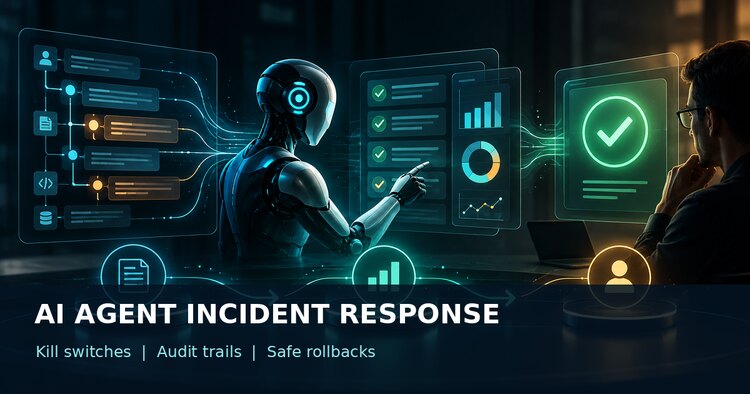
A production AI agent needs a response plan for tool misuse, duplicated writes, unsafe automation and failed approvals. This engineering runbook explains what to log, how to stop the agent, and when to resume safely.
Why AI agents need an incident response plan
An AI agent does more than generate text. It can search a knowledge base, call APIs, create records, and make changes to connected systems. That is precisely why a normal application incident checklist is not always enough. A prompt can cause an unintended tool call, a stale document can steer a decision, and a long-running task can continue after the user has moved on. In production, the goal is not to make an agent infallible. It is to detect unexpected behavior quickly, limit the damage, preserve evidence, and restore service safely. This runbook is a practical starting point for engineering teams shipping agents that interact with real tools.
Define incidents before they happen
Start by defining observable failure modes. Examples include an agent writing to the wrong customer account, repeating a paid API call, publishing content without approval, exposing information to the wrong tool, or creating an unusual volume of requests. A factual error in a draft and an unauthorized production write are not the same severity. Classify events by impact and reversibility, not by how strange the generated text looks. Document the on-call owner, the affected environment, the business owner for each connected tool, and the escalation path. If nobody knows who can stop a workflow, response time will be measured in meetings rather than minutes.
Build an audit trail across the entire agent run
A useful trace should connect the original request to the model response, selected tools, tool arguments, tool results, and the final action. Assign each run a unique ID and attach it to every step. Record the agent version, prompt template version, model identifier, policy decisions, timestamps, and whether a human approved a sensitive action. Avoid dumping passwords, tokens, private customer data, or full sensitive documents into logs. Instead, store carefully redacted payloads and stable references. Trace collection should be resilient: if the logging service is unavailable, the system must still refuse high-risk writes rather than silently skipping an approval check.
Use a kill switch that actually stops writes
A kill switch is more than a dashboard toggle. It should be enforced at the tool-execution boundary, where a write request is about to reach the database or external API. Define a global emergency stop and narrower switches by workflow, tenant, or integration. The default response to an active stop is to reject the operation and record the reason. Do not rely on telling the language model to stop: a tool permission boundary is deterministic and easier to audit. For scheduled agents, disable the scheduler as well as the worker; otherwise the queue may keep filling while responders investigate.
Separate read, draft, approve, and publish permissions
Design four distinct capabilities: reading data, generating an offline artifact, creating a private draft, and publishing publicly. These should not be interchangeable flags in a single unrestricted process. A content agent can research and produce a ZIP package without receiving production database credentials. A restricted publisher can validate that package and create a private draft. Public publishing should require a separate explicit approval step with its own audit event. This separation reduces the blast radius of prompt injection, malformed input, and ordinary software bugs. It also gives operators a safe intermediate state to inspect before a public change.
Contain the incident and preserve evidence
When an alert fires, first determine whether the agent can still act. Pause new work, disable write-capable tools, and isolate suspicious queue items. Preserve the original input package, its cryptographic hash, the execution trace, and the exact version of the agent code. If a database write may already have happened, do not blindly replay the job. Inspect the target system to identify what actually changed. For external integrations, check whether retries or timeouts created duplicate requests. Record an incident timeline that distinguishes confirmed facts from hypotheses, so later reviewers do not confuse a model-generated explanation with an observed event.
Rollback is a business operation, not just a git revert
A code rollback can stop future bad behavior, but it does not automatically undo records already created, emails already sent, or payments already captured. For each write-capable tool, define a compensating action and a human owner. Database changes should have pre-write backups or transactional boundaries when feasible. If an action cannot be reversed, such as a message sent to a customer, the incident plan must include notification and remediation. Test rollback steps on a staging system before you need them. A runbook that only says restore the backup is incomplete if nobody has verified the restore procedure.
Add evaluation gates before resuming traffic
After containment, reproduce the failure using sanitized inputs. Turn the incident into a regression test: what was the user request, which tool was called, which guardrail should have blocked it, and what result is now expected? Combine deterministic checks, such as schema validation and permission enforcement, with model-based evaluations for ambiguous reasoning tasks. Track false positives as well as misses. A guardrail that blocks all useful work is not a sustainable fix. Require a small canary run and explicit sign-off before returning the workflow to its original schedule.
A practical private-draft publishing example
Consider an editorial agent that researches AI news and prepares an article package. Its offline step generates article metadata, HTML, a featured image, and a manifest of file hashes. A queue worker validates file names, content length, category ID, private visibility, and package integrity. It then checks the CMS for an existing slug before invoking the legacy publisher. If the publisher reports success, the worker independently checks that the new database row remains private. If the result is uncertain, it marks the job for review and never retries automatically. This is safer than giving a generative agent unrestricted database access or permission to publish public content.
Metrics that tell you whether the system is improving
Measure time to detect, time to disable writes, number of duplicate actions prevented, approval bypass attempts, manual-review volume, and time to recover. Track the fraction of agent runs with complete traces and the percentage of sensitive actions that have an approval record. For publishing workflows, monitor draft QA pass rate, source verification failures, and incidents involving wrong categories or broken media. Avoid celebrating raw output volume without examining reversals and corrections. Reliability is the ability to explain and safely control what the system did, not merely the number of tasks it completed.
A ten-minute tabletop exercise
Give a teammate this scenario: a scheduled agent is about to publish a misleading article based on a poisoned search result. Ask them to locate the run ID, identify the queued artifact, disable public writes, confirm whether the CMS row is still private, and preserve the evidence. Then simulate a failed database check after the publisher returns success. The correct behavior is to stop and request review, not to assume the first call failed and repeat it. Tabletop exercises reveal missing permissions and unclear ownership before a real incident exposes them.
Implementation checklist
Before switching on unattended private-draft processing, confirm that the queue is outside the public web root, the worker code is owned by an administrator, every ZIP is size-limited and checksummed, the database duplicate check uses prepared statements, and ambiguous outcomes are quarantined. Confirm that the scheduler can be stopped independently, that logs do not contain secrets, and that human approval is mandatory for public publishing. Finally, run one end-to-end pilot with a unique slug, verify the resulting database row, and document how to disable the automation. Small, reversible steps beat a dramatic all-at-once launch.