AI Agent Evaluation in 2026: Tracing, Evals, Guardrails and Human Approval
A practical 2026 framework for evaluating AI agents with traces, repeatable evals, deterministic guardrails, human approval and safe private-draft automation.
 Netzender Editorial Team

lead
AI agents can search, call tools, edit documents, and coordinate multi-step work. But a successful demo is not the same as a dependable production workflow. Teams need a way to inspect what an agent did, measure whether it met the task, and prevent risky actions from happening without approval.
This practical guide explains how to combine tracing, repeatable evaluations, guardrails, and human review into an AI agent quality system. The examples apply to publishing workflows, support operations, research assistants, and developer agents. The objective is not to make an agent sound more confident; it is to make its behavior observable, testable, and appropriately constrained.
What does AI agent evaluation actually measure?
A traditional text-generation evaluation might compare one answer with a reference answer. An agent evaluation needs to inspect the whole journey: what the system understood, which tools it selected, what data it read, whether the tool arguments were valid, and what changes it attempted.
Consider an automated publishing agent. A fluent article is only one success criterion. The system also needs verified sources, a suitable category, an original image, valid metadata, a duplicate check, and a safe draft state. If any critical gate fails, the correct outcome may be to stop and request review.
That distinction matters because an agent can produce a convincing final answer while taking an incorrect intermediate action. Outcome checks and process checks complement each other; neither should be the only quality signal.
Tracing: the flight recorder for agent workflows
Tracing records the sequence of operations inside an agent run. Depending on the framework, traces can capture model calls, tool calls, handoffs, guardrail checks, timing, and custom application events. In the OpenAI Agents SDK, tracing is built into the normal server-side agent workflow and can be inspected to understand where a run failed.
A useful trace lets an engineer answer concrete questions: Did the agent call the correct tool? Did it retry after a timeout? Did it use the current version of a document? Did it attempt a side effect before receiving approval? When debugging, a trace is much more actionable than the final response alone.
Traces can also contain sensitive input, output, or tool data. Production teams should decide which fields to capture, how long to retain them, who may access them, and whether the configured tracing path is compatible with their data-handling obligations. Observability should not become an accidental data-leak channel.
From traces to repeatable evals
Individual traces are excellent for debugging one incident. Repeatable evaluations help determine whether a change improved the system across a representative set of tasks. Build a small dataset of real-world scenarios, including both normal requests and difficult edge cases, then run the same scenarios when prompts, models, tools, or routing rules change.
For a research-and-publishing agent, an evaluation set might include a straightforward official announcement, a rumor with no primary source, two nearly identical article topics, a broken image, a category mismatch, and an ambiguous request to publish immediately. Each case needs an expected safe outcome, not just an expected paragraph.
OpenAI documents a workflow that begins with traces and trace grading, then moves toward datasets and evaluation runs for repeatability. A grading rubric can score factual grounding, tool selection, adherence to workflow policy, and completeness. Human review remains useful for subjective quality and high-impact decisions.
Design a scorecard around measurable failure modes
An effective scorecard combines quality, safety, and operational measures. Quality includes source accuracy, completeness, readability, and whether the result answers the user’s request. Safety includes correct permission checks, no unauthorized publication, and no sensitive information exposed. Operational measures include task completion, tool failure rate, latency, and cost per successful job.
Avoid treating one overall score as proof of readiness. A system that performs well on writing quality but occasionally publishes without approval is not production-ready. Mark critical policy violations as automatic failures, even if the rest of the output looks excellent.
Keep evaluation criteria stable enough to compare releases. Record the dataset version, prompt version, model configuration, tool definitions, and the evaluation result. Without those details, a passing score may be impossible to reproduce after a change.
Guardrails: checks before and after risky steps
Guardrails validate inputs, outputs, or tool behavior against defined constraints. They can reject invalid requests, stop malformed outputs, or block tool actions that exceed the agent’s permissions. In agent SDKs, input, output, and tool guardrails can apply at different boundaries, so developers should confirm precisely when each check runs.
In a publishing system, deterministic guardrails are especially valuable. A ZIP package can be checked for path traversal, unexpected members, checksum mismatches, oversized files, invalid slugs, and incorrect visibility flags before any database write. A duplicate lookup can prevent a second article with the same slug. After draft creation, a database query can verify that status and visibility remain private.
Use deterministic checks for deterministic requirements. An LLM may help classify a topic or assess whether sources are relevant, but it should not be trusted as the only enforcement mechanism for a rule such as “never publish without approval.” That rule belongs in the application’s execution boundary.
Human approval: separate drafting from publishing
Human-in-the-loop review is a workflow state, not merely a polite instruction in a prompt. The system should be able to stop after preparing a draft, present evidence and validation results, and wait for an authorized person to approve the public action.
This separation is particularly important for external side effects: publishing a website post, sending an email, modifying a customer record, or spending money. An agent can automate the reversible preparation steps while reserving consequential actions for explicit approval.
The approval should be scoped to the exact proposed action and artifact. If the content, destination, or permissions change after approval, the system should require a fresh review rather than reusing a stale approval token.
A reference workflow for a content publishing agent
Start with topic discovery, then gather primary sources and check whether the topic already exists. Generate a draft and metadata, prepare the image, and package all required files. Validate the package locally before allowing the production publisher to read it.
Next, place the validated package in a restricted queue. A single worker takes the job, checks idempotency and database duplicates, creates a private draft, and verifies the stored row and assets. If any check fails or the outcome is ambiguous, quarantine the job and alert an operator. Do not silently retry a job that may already have written data.
Finally, a human reviews the private draft. Only a separately authorized publication path can change visibility to public. After approval, live checks should verify the page status, title hierarchy, canonical URL, images, and indexing controls. This architecture gives automation speed without making public publication an implicit side effect.
Test cases every agent team should include
Include a duplicate slug test, an invalid category test, an incorrect checksum, a malformed archive, an unavailable database, a timed-out publisher, and a publisher that prints an error but returns exit code zero. Also test the case where the database write succeeds but the final response is lost: the next run must detect the existing draft instead of creating a duplicate.
For policy coverage, test an explicit request to skip review, a prompt-injection instruction embedded in a retrieved document, and an attempted tool call outside the allowlist. For content quality, test outdated claims, conflicting sources, weak internal links, and missing attribution. The best test suite reflects the failures the business cannot afford.
Run a small smoke suite on every change and a broader regression suite before enabling a new automated schedule. Monitor production outcomes and feed newly discovered failure cases back into the dataset.
How to roll out safely without slowing the team down
Begin in offline mode, where the agent can create and validate packages but cannot access production credentials. Next, test a single private draft on a staging copy of the publisher. Verify the stored database fields and inspect the draft in the CMS. Only after a successful pilot should the team consider a restricted scheduled worker.
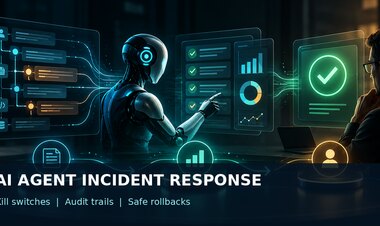
Keep a clear audit trail for each job: package hash, slug, category, timestamp, result, and draft ID. Use a lock to avoid concurrent writes, and quarantine uncertain outcomes for manual inspection. Keep backups and a documented rollback procedure for changes to the publisher itself.
A mature setup does not require every task to be fully autonomous. It requires the system to know which tasks can be automated, which failures must stop the workflow, and which decisions belong to a person.
Key takeaways
Tracing explains what an agent did; evaluations measure whether its behavior meets expectations; guardrails block prohibited actions; and human approval controls consequential side effects. Together, these practices turn a promising prototype into a more accountable operational system.
For teams building content automation, the highest-value milestone is often reliable private-draft creation with verified sources and QA—not automatic public publishing. Build confidence in that boundary first, then expand the workflow one controlled step at a time.
Related reading
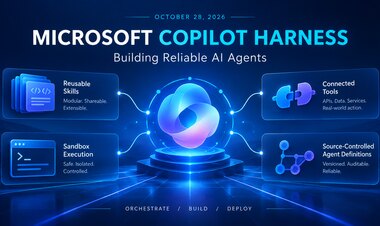
Explore our guide to agentic AI projects and engineering roadmaps, and learn how a managed execution layer works in our Microsoft Copilot harness explainer.