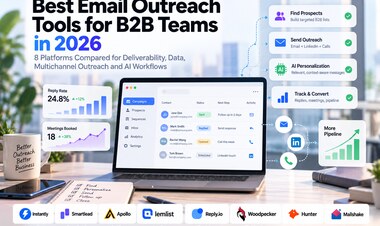
Best Email Outreach Tools for B2B Teams in 2026: 8 Platforms Compared
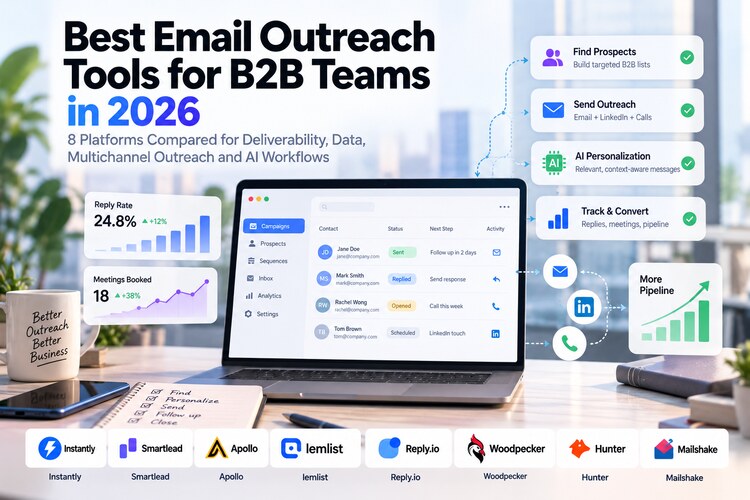
Compare 8 of the best B2B email outreach tools for 2026, including Instantly, Smartlead, Apollo, lemlist, Reply.io, Woodpecker, Hunter, and Mailshake. Choose based on deliverability, prospect data, multichannel outreach, agency scale, and AI workflows.
 Netzender Editorial Team
Cold email still works in 2026, but the software category has changed. The best outreach platforms are no longer simple mail-merge tools. They now combine mailbox management, deliverability controls, prospect data, multichannel sequences, AI-assisted personalization, reply handling, and sales workflows.
That also means there is no single “best” tool for every B2B team. An agency running dozens of sending inboxes has different requirements from a founder sending carefully researched outreach, while an SDR team may need prospect data, calls, LinkedIn tasks, CRM sync, and reporting inside one system.
This guide compares eight email outreach platforms based on the job they are best suited to perform.
Last reviewed: October 2026.
Best Email Outreach Tools for B2B Teams in 2026
| Tool | Best for | Main strength | Best team type |
|---|---|---|---|
| Instantly | Scaled cold email | Mailbox infrastructure and deliverability stack | Growth teams and agencies |
| Smartlead | Agency and multi-mailbox outreach | Sending infrastructure, warm-up and client management | Agencies and outbound operators |
| Apollo | Data plus sales engagement | B2B database and multichannel sequences | SDR and sales teams |
| lemlist | Multichannel personalization | Email, LinkedIn and calling workflows | Modern outbound teams |
| Reply.io | AI-assisted sales engagement | Sequence automation and AI sales workflows | Sales development teams |
| Woodpecker | Controlled cold email | Deliverability-focused campaign management | SMBs and agencies |
| Hunter | Finding contacts plus simple outreach | Email discovery, verification and campaigns | Small teams and founders |
| Mailshake | Straightforward sales outreach | Simple campaign operation and follow-up | Small sales teams |
What Actually Matters in a Cold Email Tool in 2026?
Feature lists can make outreach products look almost identical. In practice, five areas determine whether a platform is a good fit.
1. Deliverability controls
The platform should help you control sending volume, mailbox health, bounce risk, domain reputation, schedules, and tracking behavior. Software cannot rescue a damaged domain or poor prospect list, but it can make good sending practices easier to operate.
2. Mailbox management
Teams running multiple inboxes need rotation, sender assignment, limits, connection monitoring, and a clear way to see which mailbox sent each message.
3. Prospect data
Some products expect you to bring your own list. Others combine contact databases, email discovery, verification, enrichment, and outreach in one platform.
4. Multichannel workflows
B2B outreach increasingly combines email with LinkedIn activity, calls, tasks, CRM updates, and research rather than relying on a long automated email sequence.
5. AI that improves workflow rather than creating spam
AI is most useful when it researches an account, classifies prospects, drafts context-aware messages, summarizes replies, or decides which workflow should happen next. Generating thousands of generic emails faster is not a competitive advantage.
1. Instantly — Best for Scaled Cold Email
Instantly has developed into a broader outbound platform around cold email infrastructure.
Its current product stack includes email outreach, mailbox warm-up, lead data and enrichment, CRM functionality, inbox-placement testing, pre-warmed account options, and AI-assisted reply and sales workflows.
The reason to consider Instantly is operational scale. Teams can centralize multiple sending accounts rather than managing each inbox separately.
Best use cases
- Multiple sending inboxes and domains.
- Cold email campaigns at meaningful volume.
- Mailbox warm-up and deliverability monitoring.
- Lead enrichment and verification.
- AI-assisted replies and follow-up operations.
Best for: growth teams and agencies whose primary channel is cold email.
Watch-out: more inboxes do not compensate for poor targeting. Scale only after the campaign produces positive replies at lower volume.
2. Smartlead — Best for Agencies and Multi-Mailbox Operations
Smartlead is particularly attractive when outbound is an operating system rather than an occasional campaign.
It supports multiple lead sources, email sequences, manual tasks, calls, AI-assisted copy, reply categorization, sending safeguards, webhooks, mailbox warm-up, analytics, agency views, and client access.
Its focus on sender infrastructure and agency operation is an important differentiator.
Best use cases
- Managing outreach for multiple clients.
- Rotating campaigns across many mailboxes.
- Monitoring deliverability and mailbox health.
- Combining email with calls and manual follow-up.
- Running centralized agency analytics.
Best for: lead-generation agencies and outbound teams operating many campaigns simultaneously.
Watch-out: infrastructure complexity increases quickly. Maintain a clear inventory of domains, inboxes, clients, limits, and reputation status.
3. Apollo — Best All-in-One B2B Data and Outreach Platform
Apollo solves a different problem: prospecting and outreach inside the same environment.
Its sequences support planned touchpoints that can combine automated emails with calls, LinkedIn activity, and manual tasks. Apollo's AI assistant can also help create sequences, refine messaging, prioritize prospects, and analyze performance.
The biggest advantage is reducing the gap between finding a prospect and putting that prospect into an outbound workflow.
Best use cases
- Building B2B prospect lists.
- Enriching account and contact data.
- Email sequences.
- Call tasks and social selling steps.
- SDR workflow and pipeline generation.
- Sequence reporting and optimization.
Best for: B2B sales teams that want data and engagement in one platform.
Watch-out: an all-in-one platform is convenient, but your data quality and targeting criteria still matter more than the size of the database.
4. lemlist — Best for Multichannel Personalization
lemlist is one of the strongest options when outreach should not depend on email alone.
Its campaigns can coordinate email, LinkedIn activity, calls, manual actions, personalization, lead enrichment, and reply management. The platform also provides a unified inbox so conversations across several sending channels can be managed together.
That makes lemlist particularly useful when high-value prospects deserve more than a sequence of automated emails.
Best use cases
- Email plus LinkedIn outreach.
- Account-based prospecting.
- Calls alongside digital touchpoints.
- Highly personalized campaigns.
- Branching sequences based on prospect engagement.
Best for: B2B teams combining outbound channels around a smaller, more valuable prospect list.
Watch-out: multichannel does not mean contacting someone everywhere at once. Sequence design and pacing matter.
5. Reply.io — Best for AI-Assisted Sales Engagement
Reply.io sits closer to a sales-engagement platform than a simple cold-email sender.
It is designed around multistep outbound workflows, contact engagement, sales automation, and AI-assisted prospecting and communication.
For teams evaluating Reply.io, the main question is whether they want their outreach system to become part of the SDR workflow rather than remain a separate email tool.
Best use cases
- SDR sequences.
- AI-assisted prospect engagement.
- Multi-step follow-up.
- Sales-team collaboration.
- Automating repetitive outbound work.
Best for: sales development teams looking for a broader engagement workflow.
Watch-out: AI-written messages require review. Strong outbound usually comes from relevant account context, not automatically generated personalization tokens.
6. Woodpecker — Best for Controlled, Deliverability-Focused Outreach
Woodpecker is a good option for teams that value controlled sending and a comparatively focused cold-email workflow.
Its product emphasizes areas such as email verification, mailbox warm-up, inbox rotation, campaign management, personalization, and sender reputation.
Rather than trying to become every component of a sales stack, it remains closely aligned with the operational problem of running cold outreach safely.
Best use cases
- Small and mid-size cold-email programs.
- Agency outreach.
- Mailbox rotation.
- Deliverability-conscious campaigns.
- Personalized follow-ups.
Best for: teams that want a dedicated outreach platform without adopting a large sales-engagement suite.
7. Hunter — Best for Email Discovery, Verification and Simple Campaigns
Hunter is especially useful when finding the correct business email address is as important as sending the campaign.
Its core value is the connection between email discovery, domain search, verification, prospect lists, and campaigns.
For a founder or small team, this can eliminate the need to buy separate tools for finding addresses and sending relatively simple outreach.
Best use cases
- Finding professional email addresses.
- Verifying contact data before sending.
- Small targeted outreach campaigns.
- Founder-led sales.
- Link-building and partnership outreach.
Best for: smaller teams prioritizing accurate contact discovery and straightforward email outreach.
Watch-out: teams requiring advanced multichannel orchestration may outgrow the simpler workflow.
8. Mailshake — Best for Straightforward Sales Outreach
Mailshake remains useful for teams that want sales outreach without turning the campaign builder into an engineering project.
The platform focuses on personalized email sequences, follow-ups, lead management, sales engagement, and campaign optimization.
Its appeal is simplicity: a team can move from prospect list to campaign quickly without learning a complex automation architecture.
Best use cases
- Cold sales outreach.
- Follow-up sequences.
- Founder and small-team prospecting.
- Agency campaigns.
- Repeatable sales-development outreach.
Best for: teams that value an approachable sales-outreach workflow over maximum technical flexibility.
Which Email Outreach Tool Should You Choose?
| If your priority is... | Start with... |
|---|---|
| Scaled cold email infrastructure | Instantly |
| Agency/client campaign operation | Smartlead |
| Prospect database plus outbound | Apollo |
| Email + LinkedIn + calls | lemlist |
| AI-assisted sales engagement | Reply.io |
| Focused deliverability-conscious cold email | Woodpecker |
| Email finding and verification | Hunter |
| Simple sales sequences | Mailshake |
Deliverability Matters More Than the Tool
No outreach platform can guarantee inbox placement. The sending system is only one part of the equation.
A healthy outbound program also depends on:
- SPF, DKIM and DMARC configuration.
- Clean prospect data.
- Low bounce rates.
- Sensible volume per mailbox.
- Relevant targeting.
- Natural sending patterns.
- Clear opt-out handling.
- Monitoring domain and mailbox reputation.
Tracking also deserves scrutiny. Open tracking and link tracking can add signals and infrastructure that are not always desirable for cold campaigns. Test whether you actually need them.
Where AI Helps — and Where It Hurts
AI can make outbound significantly better when it handles information-intensive work.
Good uses of AI
- Researching the account before outreach.
- Classifying companies against an ICP.
- Summarizing recent company developments.
- Drafting a first-pass message from verified context.
- Categorizing replies.
- Identifying positive intent.
- Preparing follow-up suggestions.
Bad uses of AI
- Creating fake personalization at enormous scale.
- Inventing facts about prospects.
- Sending without review to high-value accounts.
- Generating longer emails simply because it can.
- Using automation volume as the primary success metric.
This follows the same principle as modern AI workflow automation: combine deterministic systems with AI where judgment adds value. Our guide to the best AI workflow automation tools explains that architecture in more detail.
A Practical B2B Outreach Workflow
A stronger outbound system might look like this:
- Define the ideal customer profile.
- Build a narrow account list.
- Verify contact information.
- Research account-level context.
- Rank prospects by fit and timing.
- Generate a concise first draft.
- Human-review tier-one accounts.
- Send at conservative volume.
- Use another channel when appropriate instead of endlessly emailing.
- Classify replies and update the CRM.
- Measure positive replies, meetings and pipeline — not just sends or opens.
Metrics That Actually Matter
Do not optimize an outreach program around the number of emails sent.
Useful metrics include:
- Bounce rate: a signal of list and infrastructure quality.
- Reply rate: whether people respond at all.
- Positive reply rate: much more meaningful than raw replies.
- Meetings booked: whether outreach creates conversations.
- Qualified opportunities: whether those conversations match your ICP.
- Pipeline and revenue: the final business outcome.
- Domain health: whether short-term volume is damaging future reach.
Frequently Asked Questions
What is the best cold email tool in 2026?
There is no universal winner. Instantly and Smartlead are strong candidates for scaled cold-email operations, Apollo combines prospect data with sales engagement, and lemlist is particularly useful for multichannel outreach.
Which tool is best for a small B2B team?
Hunter or Mailshake can work well for straightforward targeted outreach. Apollo can be more attractive when the team also needs a B2B prospect database.
Which outreach platform is best for agencies?
Smartlead and Instantly are commonly worth evaluating because both are designed around managing multiple sending accounts and higher-volume outbound operations.
Should I use email warm-up?
Warm-up features may be part of a broader mailbox-health strategy, but they do not replace proper authentication, clean data, conservative sending volume, relevant outreach, and ongoing reputation monitoring.
Is cold email legal?
Rules differ by jurisdiction and audience. Businesses should understand the laws that apply to their recipients, maintain accurate sender information, provide appropriate opt-out mechanisms, and avoid treating software features as legal advice.
Final Verdict
The best email outreach platform is the one that matches your operating model.
Choose Instantly when cold-email scale and infrastructure are central. Choose Smartlead for agency-style campaign operations. Choose Apollo when prospect data and outreach need to live together. Choose lemlist for personalized multichannel selling. Evaluate Reply.io for broader AI-assisted sales engagement, Woodpecker for focused cold email, Hunter when contact discovery is essential, and Mailshake when simplicity matters.
Most importantly, do not use better software merely to send more bad outreach. Better targeting, better data, a relevant reason to contact someone, and disciplined deliverability practices remain more valuable than adding another automation feature.