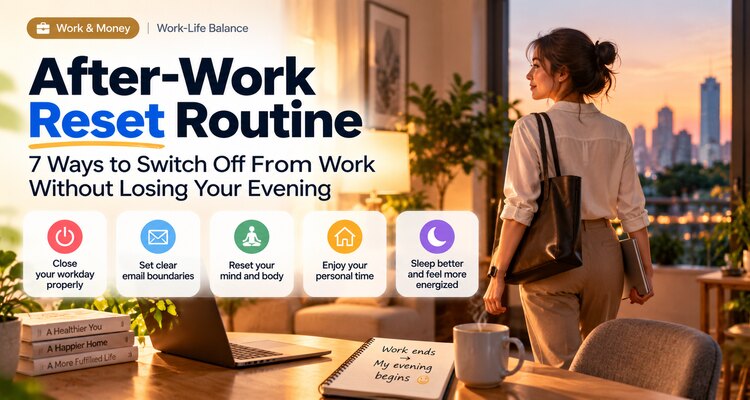
After-Work Reset Routine: 7 Ways to Switch Off From Work Without Losing Your Evening
Discover a practical after-work reset routine with seven ways to disconnect from work, set email boundaries, reduce stress and reclaim your evenings.
 Netzender Editorial Team
Your workday ends at 6 p.m., but your mind is still answering emails at 9. You close your laptop, yet keep replaying conversations, checking notifications, and thinking about tomorrow's deadlines. By the time you finally relax, most of the evening has disappeared.
If that sounds familiar, you may not need a more complicated productivity system. You may need a better transition between work and personal time.
An after-work reset routine is a short, repeatable sequence that helps signal the end of your professional responsibilities and the beginning of your evening. It can take just 10–20 minutes. The goal is not to become perfectly relaxed on command, but to make it easier to mentally detach from work and use your free time intentionally.
Below are seven practical steps, a sample 15-minute routine, and a seven-day plan for building healthier work-life boundaries.
Why switching off from work feels so difficult
Modern work rarely ends neatly when the office closes. Remote collaboration, messaging apps, flexible schedules and smartphones can make employees feel available long after their official working hours.
Even when no one is actively asking for a response, unfinished tasks can occupy attention. You may wonder whether you forgot something important, whether a colleague is waiting for an answer, or how to handle a difficult meeting tomorrow.
Occupational health research describes psychological detachment as the ability to mentally disengage from work during nonworking time. Research on recovery from job stress suggests that detachment, relaxation and control over leisure time can be important parts of recovering from work demands.
However, an evening routine cannot solve chronic understaffing, unreasonable deadlines or workplace cultures that expect constant availability. Personal habits work best alongside realistic organizational boundaries.
1. Create a clear end-of-work ritual
The first step is to stop letting work fade indefinitely into the evening. Choose a simple closing ritual that marks the end of the day.
- Write down the three most important tasks for tomorrow.
- Record unfinished items in one trusted task list.
- Close unnecessary browser tabs and work applications.
- Clear your desk or put your laptop away.
- Say to yourself: "Work is finished for today."
This ritual helps reduce the need to mentally rehearse unfinished tasks. You are not pretending the tasks have disappeared; you are giving them a reliable place to wait until tomorrow.
Try this: Spend three minutes writing tomorrow's priorities before shutting down your computer.
2. Set realistic email and messaging boundaries
For many knowledge workers, the biggest obstacle to switching off is the expectation of instant responsiveness. A notification can pull your attention back into work even when you never open the message.
Start by defining what counts as genuinely urgent. If your role includes on-call duties, agree on an escalation channel with your team. If it does not, consider muting routine work notifications outside agreed hours.
- Turn off nonessential work-app notifications after your shift.
- Use scheduled email delivery when writing messages late.
- Keep one emergency channel if your responsibilities require it.
- Communicate your availability clearly and professionally.
Instead of saying "I never answer emails after 6," try a collaborative boundary: "I check routine messages during working hours. For urgent production issues, please use the on-call channel."
Not every worker has full control over their schedule. If you face unpredictable shifts or managerial expectations, focus first on boundaries that are practical and safe within your employment situation.
3. Use a physical transition to reset your attention
A change of environment can make the transition from work to home feel more concrete. For commuters, the journey home already provides a natural boundary. For remote workers, the kitchen and office may be only a few steps apart.
Consider taking a short walk, changing clothes, stretching gently or stepping outside for fresh air. These actions are not magical stress treatments. Their value comes from creating a consistent distinction between working and nonworking time.
A ten-minute walk around the block may be especially convenient because it combines light movement with a change of scenery.
4. Give your mind a short decompression window
Immediately moving from an intense meeting to household responsibilities can feel jarring. If possible, create a small buffer before starting the next part of your day.
Choose an activity that does not require high concentration:
- Listen to a favorite song or a few minutes of music.
- Prepare a drink and sit without scrolling.
- Take a comfortable shower.
- Practice a few minutes of slow breathing.
- Look out a window or spend time outdoors.
You do not need to force yourself to meditate or follow a strict breathing technique. The purpose is to lower the intensity of the transition and give yourself permission to stop performing.
5. Stop turning every evening into another productivity project
It is tempting to treat free time as an opportunity to optimize everything: exercise, learn a language, build a side business, read a book, prepare meals and improve your sleep schedule.
Those activities can be rewarding, but an overloaded evening calendar may reproduce the pressure of the workday.
Instead, ask: "What would make tonight feel worthwhile?"
Some evenings, the answer may be a meaningful personal project. Other evenings, it may be cooking dinner, spending time with family, playing a game or resting.
Work-life balance is not about maximizing every hour. It is about making space for different parts of your life without constantly measuring their productivity.
6. Create a small boundary around your phone
Even when work notifications are muted, habitual phone checking can keep you mentally connected to your job. You may open your phone for a personal message and find yourself checking workplace chat a moment later.
Consider separating work and personal apps using your phone's focus modes or notification settings. You can also move work apps away from your home screen, or charge your phone outside the room during dinner.
For remote workers who use one device for everything, digital boundaries are especially useful because there may be no physical office door to close.
The goal is not to eliminate technology. It is to decide when technology deserves your attention.
7. Protect one meaningful evening activity
A successful reset routine should lead toward something, not simply away from work.
Choose one activity you want to protect most evenings: dinner with family, a hobby, a walk, reading, cooking, a conversation with a friend or quiet personal time.
Make the activity easy to start. Put your book where you can see it, prepare ingredients before work, or agree on a regular walk with someone you enjoy spending time with.
When your evening has a positive destination, it may become easier to resist the pull of one more email.
The 15-minute after-work reset routine
If you want a practical starting point, try the following schedule. Adjust the timing to your circumstances rather than treating it as a rigid formula.
| Time | Action | Purpose |
|---|---|---|
| Minutes 0–3 | Write tomorrow's top three priorities | Contain unfinished work |
| Minutes 3–5 | Close work apps and silence routine notifications | Establish a digital boundary |
| Minutes 5–10 | Walk, stretch or change clothes | Create a physical transition |
| Minutes 10–13 | Enjoy a quiet drink or relaxing music | Reduce stimulation |
| Minutes 13–15 | Choose one personal evening activity | Redirect attention toward life outside work |
This is a practical example, not a clinically validated 15-minute intervention. Some people need more time; others may benefit from a shorter routine.
How to switch off when you work from home
Remote workers often lack the physical cues that traditionally separate work and home. Without a commute, the same desk, screen and room may be associated with both professional demands and personal activities.
Try a simulated commute: close your laptop, put work materials out of sight, and take a brief walk before returning home. If you do not have a dedicated office, even covering your work equipment or changing your lighting can signal a shift.
People living in small spaces can create time-based boundaries rather than relying on separate rooms. For example, you might stop using your dining table for work after a certain hour.
What if your job requires evening availability?
Not everyone can disconnect at the same time each day. Healthcare workers, customer support teams, freelancers, business owners and on-call engineers may have legitimate after-hours responsibilities.
For these workers, the goal is not an unrealistic universal cutoff. Instead, define when you are actively responsible for work and when you are genuinely off duty.
When possible, establish response-time expectations, rotate on-call responsibilities, and distinguish urgent incidents from tasks that can wait. If your schedule changes frequently, use the same closing ritual whenever a shift ends.
If constant availability is causing persistent distress, a discussion with your manager or human resources team may be more effective than adding another personal productivity habit.
A seven-day work-life balance challenge
| Day | Small action |
|---|---|
| Day 1 | Write down your usual finishing time and evening work habits |
| Day 2 | Try a three-minute end-of-day task list |
| Day 3 | Review and adjust nonessential work notifications |
| Day 4 | Add a five- to ten-minute physical transition |
| Day 5 | Protect one enjoyable activity after work |
| Day 6 | Try the complete 15-minute reset routine |
| Day 7 | Review which boundaries were realistic and worth keeping |
Keep the parts that help and discard those that feel artificial. A sustainable routine should reduce friction, not create another obligation.
Common mistakes that undermine work-life balance
Checking one last message repeatedly
One quick look at work chat can easily become a series of small interruptions. Decide whether a message truly requires immediate attention before reopening work applications.
Expecting to feel calm instantly
Some days remain stressful even after a good closing ritual. A routine can support recovery without guaranteeing a particular emotional state.
Confusing rest with laziness
Recovery is not a failure to be productive. Time spent resting, connecting with people or enjoying hobbies has value beyond professional output.
Ignoring systemic workplace problems
No personal routine can fully compensate for unsustainable workloads, unsafe conditions or constant demands for availability. Addressing those problems may require organizational changes and support.
Frequently asked questions
How do I stop thinking about work after hours?
Try recording unfinished tasks before leaving work, reducing unnecessary notifications, and engaging in a personally meaningful activity. If work-related thoughts persist and significantly affect your wellbeing, consider seeking appropriate professional support.
How long should an after-work reset take?
Start with five to fifteen minutes if that is manageable. There is no scientifically established duration that works for everyone. Consistency and personal fit matter more than following an exact schedule.
Does checking work email at night affect sleep?
After-hours work demands and difficulty mentally detaching from work have been associated with poorer recovery and sleep outcomes in occupational research. The effect varies by individual and working conditions.
Can a reset routine prevent burnout?
A routine may help with everyday recovery, but burnout is linked to chronic workplace stress. Prevention also depends on workload, organizational support, autonomy and reasonable expectations.
What is the best after-work routine for remote workers?
A simple combination of a task shutdown, notification boundary and short physical transition can work well. Choose actions that fit your home environment and schedule.
Final thoughts: Your evening does not have to be a second shift
Learning to switch off from work is not about caring less about your career. It is about creating enough separation to recover, maintain relationships and enjoy a life that is bigger than your inbox.
Start with one small habit: write tomorrow's priorities, close your work apps and spend a few minutes doing something that belongs entirely to your personal life.
A good after-work reset routine does not make every evening perfect. It makes the boundary between work and life easier to recognize and protect.
Related reading on Netzender
- Build a Focus System: How to Protect Attention in a Distracting Digital Day
- Digital Wellbeing on Android: Make Your Phone Less Distracting
- One Tab at a Time: A 20-Minute Focus Ritual for Distracted Digital Workdays