Google AI Search Updates October 2026: What Publishers Should Do to Protect and Grow Traffic
Google updated AI Mode and AI Overviews in October 2026. Learn what changed, what remains experimental, and the SEO actions publishers should prioritize.
 Netzender Editorial Team
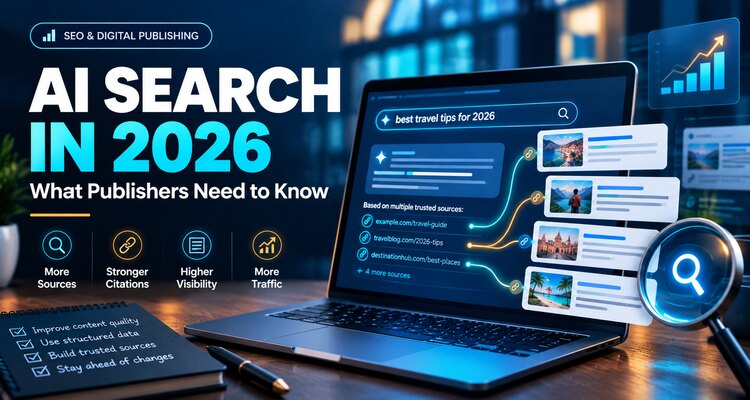
Google's October 2026 AI Search updates put website links, source visibility and publisher discovery back in the spotlight. On October 15, Google announced changes to AI Mode and AI Overviews designed to make it easier for users to move from AI-generated answers to the original websites, articles and creators behind them.
For publishers, this is a meaningful product announcement—but not proof that organic traffic is about to rebound. More visible links create potential opportunities to earn visits. Whether those opportunities translate into clicks, engagement or revenue depends on the query, the user, the website and how Google's features are displayed.
This guide separates Google's confirmed announcements from features still being tested and explains what independent publishers, bloggers and SEO teams can do next.
What Google announced on October 15, 2026
In its official announcement, More ways to connect with the web from Search, Google described five changes to how users discover sources through AI-powered search experiences.
The changes are not all at the same stage of availability. Some are ongoing improvements, some are rolling out more broadly, and others are explicitly described as tests. That distinction matters when evaluating their potential impact.
1. More inline links inside AI-generated answers
Google says it has continued increasing the presence of inline links in AI experiences and is introducing changes that place those links higher in responses more frequently.
Inline links allow a user to open a relevant source while reading an AI-generated explanation rather than searching for references elsewhere on the page.
What it means for publishers: Pages that contribute useful information may have more visible pathways to readers. However, Google has not promised that any individual site will receive additional referrals.
2. A new test highlighting official websites
Google is testing a dedicated section near the top of certain AI responses that highlights official websites and explains why each link may be useful.
This is especially relevant when someone needs an authoritative destination to complete a specific task—for example, finding the official service provider or the correct organization.
Important: Google described this as a test, not a universally available feature. Publishers should not assume every query or website can appear in this placement.
3. Timely article carousels expanding to more locations
Google says it is beginning to roll out prominent carousels for timely articles in AI Search experiences to additional countries and languages.
These carousels can surface news and reporting in a more visual format. Google also says they can highlight Preferred Sources, allowing users to recognize publications they have selected.
For news publishers, this strengthens the case for clear reporting, accurate publication dates, useful headlines and distinctive coverage. It does not guarantee carousel placement.
4. More prominent related-article links
Some AI responses already offer links to further reading. Google is making certain related-article links more engaging by adding image thumbnails and more prominent presentation.
This creates a reason to revisit editorial images and page titles. A useful, recognizable image can help readers understand what an article offers, although image quality alone does not determine whether Google will surface a page.
5. Tests of clickable creator and publisher profiles
Google says it began testing clickable creator and publisher names on video results that link to Search profiles in AI Mode.
The purpose is to provide more context about the people and publishers behind content. Eligibility and availability depend on Google's implementation, and this should not be interpreted as a new ranking factor.
For publishers with substantial video content, accurate identity information and consistent branding may help audiences recognize the source across platforms.
Why these updates matter for independent publishers
AI-generated answers can satisfy part of a user's information need before they visit a website. This creates uncertainty for sites that depend heavily on search referrals and display advertising.
Google's latest changes appear intended to make source exploration easier within AI experiences. But publishers should separate three distinct questions:
- Can users see a link to the original website?
- Will users choose to click that link?
- Will those visits generate meaningful engagement or revenue?
A more visible link helps with the first question. It does not automatically answer the second or third.
For that reason, the practical goal should be to create pages that users have a reason to open, not merely pages that an AI system can summarize.
Does Google require special AI SEO or GEO markup?
No. Google's Search Central guidance says there are no additional technical requirements or special optimizations needed to appear in AI Overviews or AI Mode. The established SEO fundamentals remain relevant.
To be eligible as a supporting link in Google's AI Search features, a page generally needs to be indexed and eligible to appear in Search with a snippet.
Structured data can help Google understand eligible content and support certain Search features, but adding arbitrary "AI schema" does not guarantee citations, inclusion or higher rankings.
Publishers should be skeptical of services promising guaranteed AI Overview placement or claiming that one hidden metadata tag can unlock AI Search traffic.
Seven SEO actions publishers should prioritize now
1. Confirm that important pages can be indexed
Before changing content strategy, verify that your most valuable pages are accessible to Googlebot and are not accidentally blocked by robots.txt, noindex directives or technical errors.
Check canonical URLs, redirects, server responses and sitemap coverage. Use Google Search Console's URL Inspection tool when diagnosing a specific page.
A beautifully optimized article cannot become an ordinary Google Search result if it is excluded from indexing.
2. Add information that cannot be replaced by a generic summary
Original screenshots, first-hand testing, transparent comparisons, clearly explained calculations and practical examples give readers a stronger reason to visit.
For a travel publisher, that might mean a tested itinerary with realistic transport considerations. For a software site, it could mean step-by-step screenshots and compatibility notes.
Do not manufacture personal experiences or claim to have tested a product when you have not.
3. Improve titles and featured images
Google's emphasis on visual related-article links makes clear, relevant imagery worth reviewing.
Use descriptive titles that match the article's actual content. Choose original or properly licensed images and provide meaningful alternative text.
Avoid misleading thumbnails or sensational headlines that promise information the article does not deliver.
4. Build topic clusters with useful internal links
A single article rarely answers every question about a complex subject. Related guides can help readers continue learning after they land on your website.
Link naturally between relevant pages, such as a general AI Search overview, a Search Console tutorial and a technical indexing checklist.
Use descriptive anchor text and prioritize genuinely useful connections rather than forcing a fixed number of links into every article.
5. Make authorship and sourcing transparent
Identify the people or organization responsible for editorial content when appropriate. Cite original announcements, official documentation and trustworthy research.
Correct outdated information and show meaningful update dates when articles change substantially.
Trust is built through consistent accuracy and transparency, not by adding decorative authority badges or unsupported claims of expertise.
6. Strengthen mobile usability and page performance
Readers arriving from search should be able to access the main content without intrusive obstacles.
Review mobile layout, image loading, readability, navigation and ad placement. Monitor Core Web Vitals where practical, but avoid treating any single performance score as a guarantee of ranking success.
Advertising should support the business without making the content difficult to read.
7. Track outcomes instead of guessing
Use Search Console to compare impressions, clicks, click-through rate and average position across meaningful time periods.
Segment by page, query, country and device when investigating changes. Combine search data with analytics information about engagement and conversions.
Google's AI Search features are not equivalent to a separate, universally available AI-citation traffic report. Avoid claiming precise AI Overview referral gains unless your measurement method actually supports that conclusion.
What publishers should not do after this update
The October announcement is not a reason to rebuild a website, remove all existing articles or purchase expensive AI optimization software.
In particular, avoid these common reactions:
- Publishing hundreds of near-identical AI-generated pages to chase citations.
- Adding unsupported schema properties marketed as special AI ranking signals.
- Blocking Googlebot without understanding the consequences for Search visibility.
- Changing every title simply because an AI Search feature was announced.
- Assuming a higher number of source links means guaranteed traffic growth.
- Replacing useful original reporting with summaries of other websites.
A measured approach is more defensible: verify technical accessibility, improve genuinely valuable pages and monitor results over time.
How to measure the impact in Google Search Console
Start with a baseline. Record the last 28 days of Search performance for your most important articles, then compare the next 28 days while accounting for seasonality, publishing activity and other changes.
Look for patterns rather than interpreting one day's movement as a trend.
| Metric | What it can tell you | Important limitation |
|---|---|---|
| Impressions | How often pages appeared in reported Search results | Not the same as actual visits |
| Clicks | Visits attributed to Google Search results | Does not explain every cause of change |
| CTR | Clicks relative to impressions | Varies by query intent and result layout |
| Average position | Reported ranking position across impressions | Can shift with query mix and Search features |
| Engagement | How visitors interact after arriving | Requires suitable analytics configuration |
| Revenue per visit | Business value of acquired traffic | Depends on monetization and audience mix |
If impressions rise while clicks remain flat, investigate the pages and queries involved. The explanation could include changing result layouts, ranking shifts, user intent or other factors—not necessarily AI Overviews alone.
Should publishers prioritize news or evergreen content?
Both formats have roles in an effective editorial strategy.
Timely reporting can capture interest around product launches and policy changes. Evergreen guides can continue answering practical questions after the news cycle ends.
Google's expanded timely-article carousels make news discovery worth watching, but a smaller independent publisher should not abandon durable content in pursuit of every announcement.
A useful approach is to publish an accurate news analysis, then connect it to a lasting guide that readers can use after the immediate update is no longer new.
A practical 30-day AI Search readiness plan
Week 1: Audit eligibility and technical foundations
Review indexing for important pages, inspect robots directives, confirm canonical URLs and fix obvious server or mobile usability issues.
Do not repeat large technical audits unnecessarily. Focus on known problems and pages with commercial or editorial value.
Week 2: Improve five high-potential articles
Select pages with relevant impressions, clear user intent and room for improvement. Add original examples, clarify outdated sections, improve images and strengthen internal links.
Document the changes so later performance comparisons have context.
Week 3: Publish one distinctive supporting guide
Choose a question that your existing articles do not fully answer. Build a useful page with clear structure, reliable sourcing and examples that are difficult to replace with a short summary.
Connect the new page to the most relevant existing content.
Week 4: Review performance and decide what to scale
Compare Search Console trends against your baseline. Identify which pages gained relevant visibility, which remained unchanged and which need further investigation.
Use the evidence to choose the next editorial priority. Do not assume every fluctuation is caused by Google's October update.
Frequently asked questions
What changed in Google AI Search in October 2026?
Google announced more prominent inline links, a test highlighting official websites, wider rollout of timely-article carousels, improved related-article presentation and tests involving clickable creator and publisher profiles.
Will the updates increase publisher traffic?
They may create additional opportunities for users to discover and click sources, but Google has not guaranteed traffic increases for individual publishers.
Do I need special structured data for AI Overviews?
No. Google's official guidance says there are no additional technical requirements or special optimizations needed for AI Overviews or AI Mode beyond established Search eligibility and SEO fundamentals.
Can a small website appear in AI Mode?
Potentially, yes. Google says AI features can surface links to a wider variety of useful pages. However, eligibility does not guarantee that a particular site will be shown.
Should I block AI crawlers to protect my content?
First distinguish between Google Search crawling, preview controls and other AI-related uses. Google documents separate controls, and blocking the wrong crawler or applying noindex can affect Search visibility.
How quickly should I expect SEO results?
There is no fixed timeline. Crawling, indexing, ranking and user behavior can change at different speeds. Use consistent measurement over several weeks or longer rather than expecting an immediate response.
Final verdict: Better source visibility is an opportunity, not a guarantee
Google's October 15 announcement makes links and source discovery more prominent in AI Search. That is relevant for publishers who depend on organic discovery, but it does not remove the uncertainty surrounding click-through behavior.
The most defensible strategy remains straightforward: publish original and useful content, keep important pages accessible to Search, connect related guides, and measure actual outcomes.
Rather than chasing unproven AI SEO shortcuts, invest in the qualities that give readers a reason to leave a summary and visit your website.
Related guides on Netzender
- Google AI Studio for Android Apps: Build, Test and Publish in 2026
- AI Content Monetization in 2026: How Publishers Can Get Paid Beyond Clicks
- AEO Mentions vs. Citations: How to Measure AI Search Visibility