Student Productivity: A Practical Study System That Beats Cramming
A practical student productivity system built around retrieval practice, spaced learning, realistic weekly planning, focus, practice exams, and sleep.
 Netzender Editorial Team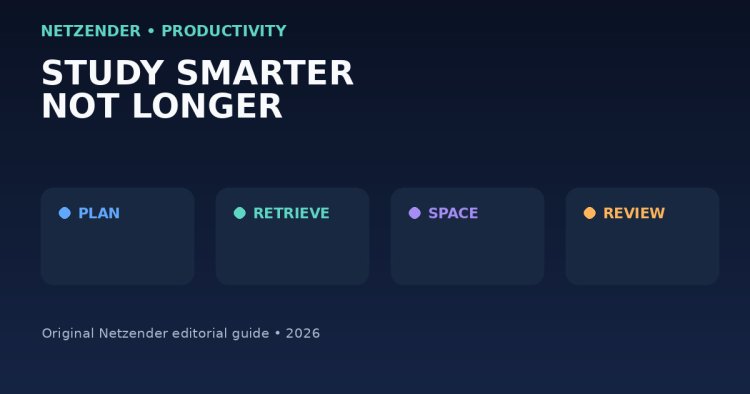
Student productivity is not about filling every hour with work. A better goal is to learn more effectively, start important work earlier, reduce avoidable distractions, and build a system that still works when several classes become busy at the same time.
The most useful study techniques are often less glamorous than a new productivity app: retrieval practice, spaced practice, realistic planning, practice tests, sleep, and focused work.
This guide turns those principles into a practical weekly system.
1. Stop Measuring Productivity by Hours
Studying for five hours does not necessarily mean five hours of learning.
A more useful question is:
What can I now explain, recall, solve, or apply that I could not do before?
Measure progress by learning outcomes and completed work, not only time spent at a desk.
2. Use Retrieval Practice
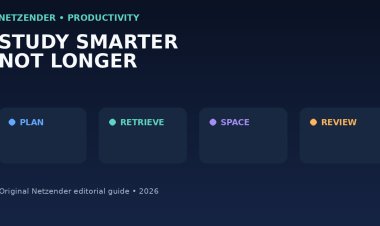
Cornell's Learning Strategies Center recommends retrieval practice: actively recalling information from memory instead of repeatedly rereading it.
Examples include:
- answering questions without notes;
- writing everything you remember on a blank page;
- using flashcards carefully;
- explaining a concept aloud;
- solving problems from memory.
The difficulty of recalling information is part of what makes the method useful.
3. Space Study Sessions
Spaced practice distributes learning across multiple sessions rather than concentrating everything immediately before an exam.
A simple pattern might be:
- first review after class;
- second review a few days later;
- practice the following week;
- final review before the exam.
The exact interval depends on the course and schedule. The principle is to revisit material before it disappears completely from memory.
4. Interleave Related Topics
Instead of studying one type of problem for a very long block, mix related concepts.
Interleaving can help students practice recognizing which method applies, not only repeating the same method after seeing an identical example.
5. Build the Week Before Building the Day
Daily task lists are useful, but they can become unrealistic if you never look at the whole week.
At the start of the week, identify:
- classes;
- deadlines;
- exams;
- assignments;
- work commitments;
- travel time;
- exercise;
- personal obligations.
Then decide where focused study blocks realistically fit.
6. Break Assignments Into Visible Actions
“Write essay” is too large to be a useful task.
Break it into:
- choose topic;
- find five sources;
- read and annotate;
- draft thesis;
- create outline;
- write section one;
- write section two;
- revise;
- proofread;
- submit.
Small visible actions reduce the friction of getting started.
7. Use Practice Exams Properly
Cornell recommends simulating real exam conditions where possible.
If the real exam is timed, time the practice. If it is closed book, practice without notes. If multiple practice exams are available, use one early to diagnose weaknesses and another later to evaluate improvement.
8. Protect Focus
UT Austin's student-learning resources highlight both internal and external distractions as barriers to concentration.
Before a focus block:
- silence unnecessary notifications;
- close irrelevant tabs;
- put the phone out of easy reach;
- prepare the materials you need;
- define the exact task.
The goal is not perfect concentration. It is making distraction less convenient.
9. Use a Short Startup Ritual
A repeatable start can reduce procrastination.
For example:
- clear the desk;
- open only required material;
- write the goal for the session;
- set a work interval;
- begin with a specific question or problem.
10. Match the Tool to the Work
Use a calendar for events and fixed deadlines.
Use a task list for actions.
Use notes for information.
Use flashcards for recall when appropriate.
Do not force one productivity app to become your calendar, textbook, memory system, project manager, journal, and distraction.
11. Plan With Buffers
Students often plan as if every task will take the minimum possible time.
Build extra room for:
- difficult readings;
- technical problems;
- group projects;
- unexpected deadlines;
- illness;
- fatigue;
- revision.
12. Review Your System Weekly
Ask:
- Which tasks kept getting delayed?
- Which courses need more practice?
- Where did I underestimate time?
- Which study methods actually helped?
- What should I change next week?
A productivity system should adapt instead of becoming another rule you feel guilty about breaking.
13. Do Not Replace Learning With AI
AI can explain, quiz, summarize, and generate practice material. But having an AI produce the answer is not the same as learning the material.
A 2026 Stanford SCALE repository entry on AI-assisted pretesting reported that longer-term gains still depended on structured retrieval-based practice.
A useful AI workflow is therefore:
Attempt → Ask → Compare → Correct → Retrieve again.
14. Protect Sleep
Cornell's study guidance explicitly emphasizes sleep, nutrition, hydration, and a study plan rather than all-night cramming.
Reducing sleep to create more “study hours” can undermine the learning those hours are supposed to produce.
15. Use SMART Goals for Larger Projects
For semester-level goals, use a clear target with a deadline and measurable progress.
Instead of:
I should improve my math.
Try:
I will complete two closed-book problem sets each week and review every incorrect answer before Friday.
16. Create a Minimum Viable Study Day
Some days will not go according to plan.
Define the smallest useful version of your routine:
- review tomorrow's deadlines;
- complete the highest-risk task;
- do one retrieval session;
- prepare materials for the next day.
This prevents one difficult day from becoming an abandoned week.
A Simple Weekly Student System
Sunday or Monday: Review deadlines and schedule focus blocks.
After each class: Short recall-based review.
Midweek: Work on assignments before they become urgent.
Before exams: Use retrieval and realistic practice conditions.
End of week: Review what worked and update the next week.
Student Productivity Checklist
- Plan the whole week.
- Break large assignments into actions.
- Use retrieval practice.
- Space learning across days.
- Mix related problem types.
- Practice under exam-like conditions.
- Reduce environmental distractions.
- Protect sleep.
- Use AI as a study assistant, not a substitute.
- Review and adjust the system weekly.
Browse more practical workflows in our Productivity section.
Final Takeaway
The most effective student productivity system is not the one with the most apps or the most complicated schedule.
Build around evidence-backed learning methods, realistic planning, focused work, and regular review. Productivity should make learning easier to sustain, not turn studying into another full-time management project.