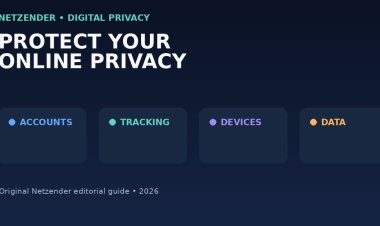
How to Protect Your Privacy Online: A Practical 2026 Checklist
A practical online privacy checklist covering accounts, tracking, permissions, location sharing, devices, phishing, and everyday data exposure.
 Netzender Editorial Team
Online privacy is not a single setting you turn on once. It is a collection of decisions about what information you share, which companies can track you, how securely your accounts are protected, and what your devices reveal about you.
The practical goal is not to become invisible online. For most people, that is unrealistic. A better goal is to reduce unnecessary data exposure, make account takeovers harder, and understand which permissions and tracking systems you are accepting.
Start With the Accounts That Matter Most
Your email account is often the recovery key for everything else. If someone gains access to it, they may be able to reset passwords for banking, shopping, social media, cloud storage, and other services.
Prioritize:
- your primary email account;
- banking and payment services;
- password manager;
- Apple, Google, or Microsoft account;
- social accounts;
- cloud storage;
- work accounts.
1. Use Unique Passwords
Reusing one password across many sites creates a chain reaction. If one service is compromised, attackers can test the same credentials elsewhere.
Use a password manager if possible. The important part is not memorizing dozens of complicated strings. It is making sure one compromised service does not automatically expose the others.
2. Turn On Multi-Factor Authentication
Enable two-factor or multi-factor authentication on important accounts.
Authentication apps, security keys, passkeys, and other stronger methods can reduce dependence on passwords alone. The exact options depend on the service.
FTC consumer guidance recommends two-factor authentication as an important account-protection measure.
3. Review Privacy Settings Instead of Accepting Defaults
Devices, apps, browsers, and social networks frequently offer privacy controls that most people never revisit after setup.
Review who can see:
- your profile;
- posts;
- contact information;
- friend or follower lists;
- activity status;
- location;
- photos and metadata.
Privacy defaults are designed for a broad audience. They may not match your preferences.
4. Audit App Permissions
Check what each mobile app can access.
Common permissions include:
- location;
- camera;
- microphone;
- contacts;
- photos;
- Bluetooth;
- local network;
- notifications.
Ask a simple question: Does this app need this permission to perform the function I use?
A weather app may reasonably need approximate location. A basic calculator usually does not need your contacts.
5. Understand Online Tracking
Websites and apps can collect information using cookies, pixels, advertising identifiers, and other techniques. The FTC also describes device fingerprinting as one way online activity can be tracked.
Tracking may be used to remember preferences, measure analytics, personalize content, or deliver targeted advertising.
The important distinction is that tracking can happen both on the service you are using and across services through third parties.
6. Review Browser Privacy Controls
Modern browsers provide controls for cookies, tracking protection, site permissions, stored data, pop-ups, location, camera, and microphone access.
Review these periodically rather than installing every privacy extension you encounter.
More extensions are not automatically safer. Extensions themselves can have broad access to browser activity.
7. Delete Data You No Longer Need
Old accounts, saved payment methods, stored addresses, uploaded documents, and years of unnecessary account history increase the amount of information that can be exposed.
Review old services and delete accounts you no longer use when deletion is available and appropriate.
8. Be Selective With Location Sharing
Location can be useful for navigation, ride sharing, weather, and local services. It can also reveal patterns about where you live, work, shop, or spend time.
Use options such as approximate location, only-while-using-the-app access, or no location access when they meet your needs.
9. Think Before Uploading Sensitive Documents
AI tools, cloud services, form builders, scanning apps, and productivity platforms make uploading files easy.
Before uploading a document containing financial, identity, customer, health, employment, or confidential business information, check:
- why the service needs it;
- how it will be stored;
- whether you can delete it;
- whether the service uses uploaded content for additional purposes;
- whether your organization permits the upload.
10. Watch for Phishing
Many privacy incidents begin with social engineering rather than advanced hacking.
Be cautious when a message pressures you to:
- verify a password;
- open an unexpected attachment;
- send a verification code;
- move a conversation off-platform;
- make an urgent payment;
- share personal information.
Navigate to the company's official site or app yourself instead of trusting an unexpected link.
11. Secure Your Devices
Keep operating systems, browsers, and important apps updated. Use a device lock. Enable device encryption where supported and appropriate.
Remember that privacy and security overlap. A perfectly configured social profile does not help much if someone can unlock your phone.
12. Review Connected Devices and Sessions
Many major platforms show devices or login sessions connected to your account.
Review the list occasionally and remove devices you no longer recognize or use.
13. Limit Data Shared With People-Search and Data-Broker Services
Public records and commercial data sources can make personal information surprisingly easy to locate.
The FTC provides consumer guidance about people-search sites and opting out where available.
14. Separate Public and Private Information
Information that seems harmless in isolation can become revealing when combined.
A public birthday, workplace, family names, travel plans, phone number, and location-tagged photos can create a much more detailed profile together.
15. Review Privacy Quarterly
Privacy is easier to maintain when it becomes a routine.
Every few months:
- review important accounts;
- remove unused apps;
- check permissions;
- review logged-in devices;
- delete obsolete accounts;
- check location sharing;
- update recovery information.
A Practical Privacy Checklist
- Unique passwords for important accounts.
- MFA enabled.
- Email account strongly protected.
- Unused apps removed.
- App permissions reviewed.
- Location sharing minimized.
- Browser privacy controls reviewed.
- Old accounts deleted where appropriate.
- Connected devices checked.
- Sensitive files uploaded only when necessary.
- Unexpected links treated cautiously.
- Software kept current.
Browse more guides in our Privacy & Security section.
Final Takeaway
You do not need extreme measures to improve everyday privacy. The highest-value actions are usually straightforward: protect important accounts, reduce unnecessary permissions, understand tracking, share less by default, and review your settings periodically.