
2027 401(k) and IRA Contribution Limits: What Changed and How Much Can You Save?
The IRS raised the 2027 401(k) limit to $25,500 while the IRA limit remains $7,500. Compare catch-up rules, income phase-outs and savings examples.
 Netzender Editorial Team
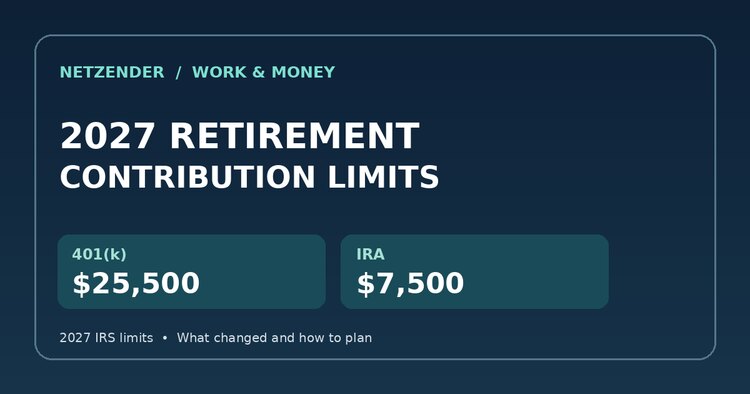
Quick answer: For 2027, the IRS raised the employee contribution limit for most 401(k) plans to $25,500, up from $24,500 in 2026. The combined annual contribution limit for traditional and Roth IRAs remains $7,500. Eligible workers age 50 or older may be able to contribute more through catch-up rules. These figures apply to contributions for the 2027 tax year, not 2026. IRS announcement, November 12, 2026.
Updated November 13, 2026. This article provides general US retirement-planning information, not personalized investment, tax, or legal advice. Plan terms, eligibility, compensation, and IRS rules may affect your individual limit.
The headline increase is easy to remember, but the details matter if you are approaching age 50, juggling more than one employer, saving through a Roth account, or running a small business. Below is a practical guide to what changed, what stayed the same, and how to turn annual limits into a realistic payroll savings target.
2027 retirement contribution limits at a glance
| Contribution category | 2026 | 2027 | Change |
|---|---|---|---|
| 401(k) employee elective deferral (under 50) | $24,500 | $25,500 | +$1,000 |
| 401(k) standard catch-up, age 50+ | $8,000 | $8,500 | +$500 |
| 401(k) higher catch-up, ages 60–63 | $11,250 | $11,750 | +$500 |
| IRA annual contribution (under 50) | $7,500 | $7,500 | No change |
| IRA catch-up, age 50+ | $1,100 | $1,100 | No change |
| Most SIMPLE retirement plans, standard deferral | $17,000 | $17,500 | +$500 |
Figures reflect the IRS 2027 announcement and the prior-year IRS limits. Some SIMPLE plans have higher special limits. Catch-up contributions are available only when applicable requirements and plan provisions are met. See IRS Notice 2026-66 for the technical tables.
What changed for 401(k), 403(b), governmental 457 plans and the TSP?
The general employee elective-deferral ceiling is now $25,500 for 2027. This applies to many workers participating in 401(k) and 403(b) plans, eligible governmental 457 plans, and the federal Thrift Savings Plan. It is the employee contribution limit—not the maximum combined amount that an employee and employer can put into an account.
For someone paid every two weeks, reaching $25,500 over 26 paychecks would mean contributing about $981 per paycheck, before considering employer matching, contribution timing, payroll rounding, or plan-specific rules. Over 12 months, the same target is $2,125 per month. You do not need to contribute the maximum to benefit from tax-advantaged saving.
Catch-up contributions for ages 50 and older
In 2027, the general 401(k)-type catch-up amount rises to $8,500. If eligible, someone age 50 or older can generally defer up to $34,000 ($25,500 plus $8,500). That is an annual ceiling, not a recommendation for everyone. Your plan must permit the relevant catch-up feature, and applicable compensation and other rules still apply.
Special higher catch-up for ages 60 through 63
The SECURE 2.0 higher catch-up amount for eligible participants who turn 60, 61, 62, or 63 during 2027 is $11,750. Combined with the regular employee limit, that can allow up to $37,250 in employee elective deferrals for the year. Do not add the $11,750 on top of the ordinary $8,500 catch-up: the higher amount replaces it for qualifying participants.
Some higher-income employees must make catch-up contributions on a Roth basis under applicable SECURE 2.0 rules. Confirm the prior-year wage threshold and your employer plan’s implementation with the plan administrator; the Roth treatment is separate from the size of the annual limit.
What stayed the same for traditional and Roth IRAs?
The 2027 IRA contribution limit stays at $7,500 for individuals under age 50. The additional IRA catch-up for people age 50 or older remains $1,100, making the combined potential annual contribution $8,600. These are shared limits across your traditional and Roth IRAs, not separate allowances for each account type.
For example, if you contribute $4,000 to a traditional IRA and $3,500 to a Roth IRA in 2027, you have used the full $7,500 basic IRA contribution allowance. Contributing $7,500 to each would exceed the shared limit unless another rule specifically applied. Contributions also generally cannot exceed eligible taxable compensation.
Roth IRA income phase-outs in 2027
A Roth IRA is not automatically available at every income level. For 2027, the IRS says the Roth IRA contribution income phase-out is $158,000–$173,000 for single filers and heads of household, and $250,000–$260,000 for married couples filing jointly. Married taxpayers filing separately face different rules. Eligibility depends on modified adjusted gross income and filing status, so check the IRS rules before funding an account.
Traditional IRA deduction limits are different from contribution limits
Being allowed to contribute to a traditional IRA does not always mean you can deduct the full contribution. If you or your spouse participates in a workplace retirement plan, income-based deduction phase-outs may apply. For a single filer covered by a workplace plan, the 2027 deduction phase-out is $83,000–$93,000; for married filing jointly when the contributing spouse is covered, it is $133,000–$153,000. Different thresholds apply when only the other spouse is covered.
2027 savings examples: how much per paycheck?
These examples divide the annual limit into equal contributions. They are planning illustrations, not instructions to maximize contributions regardless of your emergency savings, debt, or household budget.
| Goal | Per month (12) | Per biweekly paycheck (26) |
|---|---|---|
| 401(k), under 50: $25,500 | $2,125.00 | $980.77 |
| 401(k), 50+: $34,000 | $2,833.33 | $1,307.69 |
| 401(k), ages 60–63: $37,250 | $3,104.17 | $1,432.69 |
| IRA, under 50: $7,500 | $625.00 | $288.46 |
| IRA, 50+: $8,600 | $716.67 | $330.77 |
If your employer offers matching contributions, understand its matching formula and whether it has a year-end true-up provision. Maxing out too early could reduce matching in some plan designs. Payroll limits, rounding and pay periods also matter. Check your benefits portal before changing your contribution percentage.
What freelancers and small-business owners should check
Self-employed workers may have options such as a solo 401(k), SEP IRA, or SIMPLE IRA, depending on their business structure, employees, compensation, and plan documents. These accounts do not all use the same calculation. A solo 401(k) can involve an employee deferral and a separate employer contribution, but the employer portion is subject to distinct rules and an overall defined-contribution ceiling.
If you work a day job and also earn freelance income, do not assume you get a fresh employee 401(k) deferral limit for each plan. Employee elective deferrals across plans generally must be coordinated. An employer contribution may be calculated differently, and special cases can be complex. A qualified tax professional or plan administrator can help avoid excess contributions.
For SIMPLE retirement plans, the standard 2027 employee deferral limit is $17,500. The IRS also lists a higher $19,100 limit for certain applicable SIMPLE plans. Catch-up amounts vary by age and plan type. Verify which category your employer or business plan uses before entering a number into payroll.
How does the 2027 Saver’s Match fit in?
A retirement contribution limit tells you how much you may be allowed to put into a qualifying account. The federal Saver’s Match is a separate government matching mechanism with its own eligibility, income and contribution rules. A higher 401(k) limit does not automatically mean you qualify for the match, and the match is not an extra personal IRA contribution allowance.
For an overview of the separate program, read our 2027 Saver’s Match eligibility and income limits guide. Review current IRS guidance before assuming a specific contribution will qualify.
Five common mistakes to avoid
- Mixing up tax years: The 2027 limits apply to the 2027 contribution year, not contributions already made in 2026.
- Double-counting IRA limits: Traditional and Roth IRA contributions share a combined annual limit.
- Adding both catch-up amounts: The special ages 60–63 catch-up generally replaces the standard catch-up, rather than stacking on top.
- Confusing employee and employer limits: The $25,500 employee deferral ceiling is not the same as the overall plan contribution cap.
- Ignoring income and plan eligibility: Roth IRA income limits, traditional IRA deduction rules, and plan-specific provisions can change what you can do.
2027 retirement contribution limits: frequently asked questions
Can I contribute to both a 401(k) and an IRA in 2027?
Often yes. The 401(k) employee deferral limit and the IRA contribution limit are separate, although IRA deductibility, Roth IRA eligibility, compensation requirements, and other rules may restrict the tax benefits or contributions available to you.
Did the IRA limit increase for 2027?
No. The standard IRA limit remains $7,500, and the IRA catch-up for people age 50 or older remains $1,100, according to the IRS announcement.
How much can a 55-year-old put into a 401(k) in 2027?
Generally up to $34,000 in employee elective deferrals if eligible and the plan permits catch-up contributions: the $25,500 basic limit plus $8,500 standard catch-up. Employer contributions are subject to separate rules.
What is the maximum for a 61-year-old in 2027?
For an eligible participant in a plan offering the higher catch-up, the potential employee deferral ceiling is $37,250: $25,500 plus the special $11,750 catch-up for ages 60–63.
Does a higher limit mean I should max out my account?
Not necessarily. Consider your emergency fund, high-interest debt, employer match, cash-flow needs, and long-term goals. The IRS maximum is a legal ceiling, not a personalized savings target.
Where can I verify the numbers?
Start with the official IRS 2027 announcement and Notice 2026-66. For plan-specific details, consult your employer’s benefits administrator or retirement plan provider.
Bottom line: set a sustainable target, then check the rules
The biggest 2027 headline is the $1,000 increase in the standard employee 401(k) deferral limit. IRA contributions stay flat, while catch-up allowances offer additional room for eligible older savers. Use the numbers as a planning starting point, not a promise of tax savings. A small, consistent contribution that fits your budget may be more useful than an unrealistic maximum.
Sources: IRS, November 12, 2026; Notice 2026-66; IRS 2026 comparison announcement; IRS plan contribution guidance.