Black Friday Spending Limit: How Much Can You Afford Before Your Next Payday?
Work out how much cash you can use for Black Friday and Cyber Monday before your next paycheck. A six-line worksheet and three household examples show how bills, timing and a buffer change the answer.
 Netzender Editorial Team
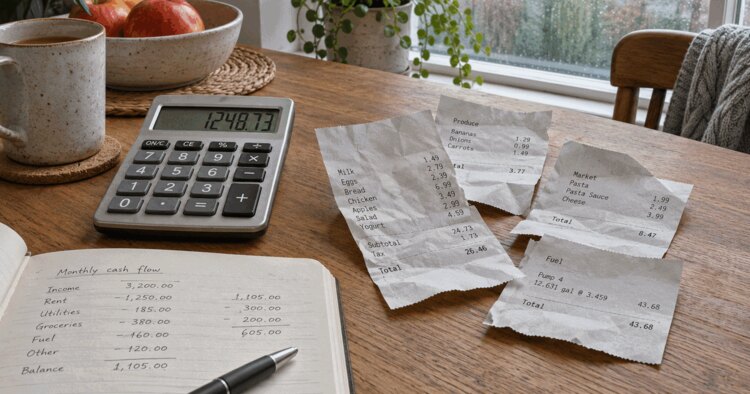
A $1,500 checking balance can leave room for just $300 of Black Friday shopping. In this example, $650 already belongs to bills, $300 will buy groceries and transportation, and $250 needs to stay available for surprises. Put a $200 order through checkout and you have $100 left for the rest of the weekend.
To find your own spending limit, work from today through the moment your next reliable paycheck clears. Subtract the bills, essentials and cushion you need over that period. Then check the dates. If your account would run short on Tuesday, a deposit on Thursday cannot fund a purchase today.
How much can you spend before payday?
Start with cash you could actually spend today. Open your bank app and check which transactions have already reduced the available balance. A restaurant tip, a check you mailed or an order awaiting shipment may still be missing. Reserve those amounts once. Leave out overdraft protection, available credit and money set aside for another purpose.
Draw a line on your calendar at the next reliable payday. Include expenses due on payday itself if they might leave the account before your pay arrives. If you get paid monthly and have already set aside part of this paycheck for next month’s rent, keep that money earmarked even if the rent falls just outside the window. A short-term calculation works alongside your monthly plan. Consumer.gov’s budgeting worksheet can help you build that longer view from bills and pay stubs.
Black Friday budget calculator
Estimated spending limit = available cash + confirmed income arriving before payday − upcoming bills − essential expenses − emergency buffer. When the result is negative, the shopping limit is zero. Keep the negative figure separately so you can see the size of the gap. Subtract the full checkout total of your planned purchases from the limit to see how much room remains.
| Enter your figures in one currency | Example (USD) | What belongs here |
|---|---|---|
| Available cash | $1,500 | Spendable cash after outstanding transactions and earmarked savings |
| Income before payday | $0 | Confirmed deposits inside the window, excluding the paycheck that ends it |
| Upcoming bills | $650 | Housing, utilities, debt payments and scheduled installments |
| Essential expenses | $300 | Food, transit, medicine and other needs still to be paid |
| Emergency buffer | $250 | Cash you choose to keep available for surprises |
| Planned purchases | $200 | Combined checkout totals across stores, including delivery and tax |
Run the example with a phone calculator. Subtract $650, $300 and $250 from $1,500 to get $300. Subtract the proposed $200 order to get $100 remaining. You can use pounds, Canadian dollars or Australian dollars just as easily. Use your local checkout total and the same currency on every line.
Check the lowest balance before placing an order
List each deposit and payment in date order. Start with today’s cash, set aside the buffer, then work down the list and note the lowest running balance, including today. The amount you can spend immediately is at most that low point, with a floor of zero. Suppose you have $350 today, a $300 bill tomorrow and a confirmed $400 deposit the following day. With a $50 buffer, today’s shopping room is zero. Recalculate when the deposit clears.
Three households, three different answers
A couple buying gifts has $300 of room
The first household uses the figures in the worksheet. Both partners see a $300 limit. One buys a $120 gift and the other spends $80, each including delivery. Recording both purchases in a shared note leaves $100 between them. If either partner treats the original $300 as a personal allowance, the second order can quietly spend the same money twice.
A weekly paycheck leaves exactly enough for essentials
A commuter has $460 on Friday, with $240 due for bills, $150 needed for groceries and bus fares, and $70 set aside for unexpected costs. There is no other income before payday. The spending limit comes to exactly zero. An $80 pair of discounted shoes would put the plan $80 over. The commuter saves the model number and price to compare after the next paycheck.
A freelancer faces a $90 shortfall
A freelancer has $620 in cash, $420 in upcoming bills, $210 of essential spending and an $80 buffer. An unpaid invoice has no confirmed settlement date, so the income field stays at zero. The calculation gives minus $90. Even skipping shopping leaves a gap against the plan. If the invoice clears later, the freelancer can enter the deposit once, update bills already paid and calculate again.
Which deals deserve space in the budget?
Write down the job an item needs to do and the maximum you intended to pay before opening a sale page. If your only winter coat has a broken zipper, compare the cost of a repair with the delivered price of a replacement. If you already set aside money for that coat in your essentials estimate, charge the purchase to that line. Counting it again under gifts would understate what remains.
For optional purchases, compare the same model, size and included accessories at two stores. A $74 item with $12 shipping costs $86 before tax. An $82 offer with free delivery could cost less. Check the final totals and who pays return postage. The FTC’s online shopping guide explains how to compare offers and why it pays to save the receipt. For a trip purchased during a sale, use the same exercise with baggage and booking charges. See how travel fees change the final price.
How should buy now, pay later fit?
Enter installments from existing plans under upcoming bills if they fall inside this pay window. For a new optional purchase, test the entire price against the shopping limit first. A $200 purchase advertised at $50 per installment still commits $200. Reserving the full amount now gives you a way to pay later installments even if next month’s income changes. As installments clear, reduce the reserve by the same amount to avoid counting the cost twice.
The US Consumer Financial Protection Bureau describes a common arrangement of four payments spaced two weeks apart. Terms vary, including when the first payment is due and what a missed payment costs. Read your own agreement and place every due date on the calendar. Read the CFPB’s explanation of installment loans.
Give Black Friday and Cyber Monday one budget
In 2026, Black Friday falls on November 27 and Cyber Monday on November 30. Set one figure for both when they fall in the same pay window. Someone with $300 available might reserve $100 for Monday and cap Friday orders at $200. An unplanned $25 shipping charge on Friday reduces Monday’s room by $25 unless another item comes out of the cart.
Deduct an order when you place it. A pending return can stay in a separate note until the refund is available to spend. Before accepting a shopping assistant’s suggested bundle, check the basket quantity and final price. Netzender’s guide to shopping controls shows where to look. If sale alerts keep reopening a decision you have already made, set a boundary for holiday notifications and review your list once on Monday.
What if the spending limit is zero?
Check the input that drove the result. A pending debit may already have been reflected in your opening balance. A bill may be listed twice. If the figures are correct, write down which payment comes first and how much cash will be available that day. If covering a bill looks difficult, contact the provider before it falls due to ask what payment options are available. For gift giving, a shared meal from groceries already budgeted or an agreed price cap can keep the occasion on the calendar.
Frequently asked questions
Should I include my next paycheck?
The paycheck that ends this calculation starts the next pay window. Include a separate earlier deposit only if its date and net amount are reliable. If a payment is delayed, update the calendar before checking out.
How large should the buffer be?
Look at a recent pay period similar to this one. What did an extra grocery run, a prescription refill or an unexpected ride home cost? Choose a cushion that fits your circumstances. Keep known expenses on their own lines so the cushion remains available for surprises.
Can a gift card increase what I can buy?
A store gift card can reduce the cash needed for a planned purchase at that store. Apply it to the cart and enter the amount still payable, including any charges the card does not cover. Keep the card out of available cash because it cannot pay your rent or electricity bill.