Google Genie 4 Explained: Features, Access, Limitations and Real-World Uses
Explore Google Genie 4, its interactive world simulations, native audio, research preview access, practical uses, pricing status and current limitations.
 Netzender Editorial Team
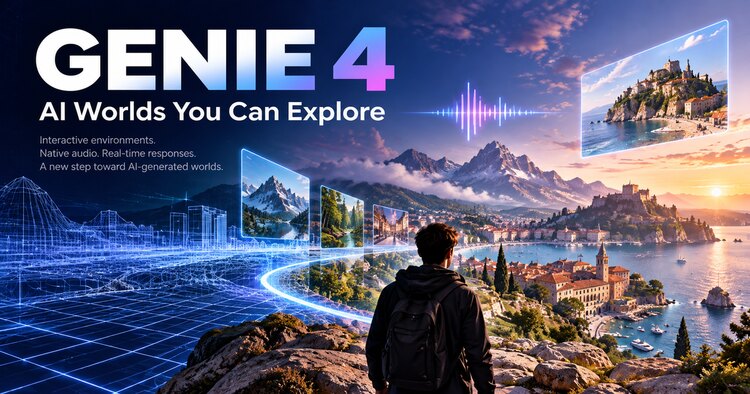
Updated October 28, 2026. Google DeepMind has introduced Genie 4, an experimental AI world model that can generate interactive scenes with native sound. This guide separates announced capabilities from actual access, practical applications and important limitations.
What is Google Genie 4?
Google DeepMind announced Genie 4 on October 27, 2026 as an experimental world model that generates interactive simulated environments. Unlike a conventional text-to-video tool that delivers a finished clip, Genie 4 is designed to respond as people explore and change a scene. Google describes it as a research system rather than a generally available consumer product. This distinction matters: impressive demonstrations do not mean every reader can access the model today.
How Genie 4 works differently from AI video
A traditional generative video workflow starts with a prompt and outputs a sequence to watch. A world model attempts to keep generating the next visual and audio state while someone interacts with the environment. Genie 4 can be steered with natural-language instructions, including requests to introduce events, change conditions or adjust the scene. That does not make it a complete game engine: developers still need to assess controls, persistence, repeatability, rights and production integration.
Native audio and responsive dialogue
Google says Genie 4 generates environmental audio, music-like sounds and character dialogue alongside the simulated world. That is significant because audio and visual reactions are produced together rather than assembled only after a clip has been rendered. In demonstrations, a scene may react to a new instruction while the session continues. The accuracy of speech and synchronization remain research challenges, so readers should not assume studio-ready sound or reliable dialogue in every scenario.
Physics, people and visual realism
Google highlights advances in physical interactions, fluid character motion, natural-looking environments and reactions to changing circumstances. Demonstrations include different environments and objects, but they are selected examples, not proof that every real-world event is faithfully simulated. Object permanence, complex collisions, spatial accuracy and long-term consistency can still fail. Treat Genie 4 as a prototyping environment rather than a verified physics simulator for safety-critical decisions.
Gemini models and multi-step simulation
According to DeepMind, Gemini-family models contribute reasoning and planning capabilities while Genie 4 generates the sensory world. Google describes experiments where a guiding model observes simulated frames, decomposes goals into steps and adjusts its plan as a scene changes. This is especially interesting for researchers studying embodied AI, robots and autonomous agents. However, a promising research demonstration is not equivalent to a validated training pipeline or guaranteed transfer from simulation to real-world robotics.
Who can access Genie 4 in October 2026?
At announcement, Genie 4 is available as a research preview to trusted testers. Google says it plans to expand access to Google AI Ultra subscribers through Project Genie and selected partners using the Gemini API and Google AI Studio. The official announcement does not establish that every Ultra subscriber has immediate access, nor does it provide a confirmed universal rollout date. Interested readers should consult the official DeepMind Genie page and waitlist rather than paying third-party sellers who promise instant access.
Is Genie 4 free? Pricing and API availability
Google has not published a generally available Genie 4 API price or universal free tier in its launch announcement. Future access may depend on subscription eligibility, geography, invitation status or partner programs. Avoid treating speculative per-minute prices and unofficial benchmark claims as confirmed facts. Before building a commercial workflow, verify the current terms, quotas, content policies and access documentation directly from Google.
Practical use cases worth watching
Creative teams could explore interactive storyboards, experiment with camera movement and rapidly test scene concepts. Game designers may be able to prototype a playable atmosphere before committing to assets and code. Educators and journalists could investigate immersive representations of historical or hypothetical scenarios, while clearly identifying generated content and uncertainty. Robotics and agent researchers may explore varied simulated conditions. All of these are possibilities under investigation, not guarantees of production readiness.
Current limitations and risks
DeepMind cautions that visual details and objects can drift as sessions get longer or prompts become more complex. Spatial fidelity, text rendering, complex physics, real-time audio and multi-agent interactions are still imperfect. An AI-generated historical scene is not a documentary reconstruction, and an AI-generated location is not a reliable map. Google says generated video and audio will carry SynthID watermarking. Teams should also review rights, privacy, safety and human oversight before sharing simulated media.
Genie 4 versus Genie 3
The headline changes are stronger realism, native audio and more responsive interactions. Genie 3 helped establish real-time generated environments, while Genie 4 pushes toward richer human behavior and sound. Comparisons should remain qualitative until independent, reproducible evaluations and full technical specifications are available. Avoid assigning exact performance gains, resolution guarantees or fixed frame rates unless Google publishes verifiable measurements for the relevant access tier.
What to do next
Start with Google’s official DeepMind announcement and model page, confirm whether you qualify for the research preview or waitlist, and document a specific use case before planning an integration. For teams already experimenting with AI agents, read Netzender’s agentic AI engineering roadmap; for Android app prototypes, see our Google AI Studio guide. Revisit access and pricing when Google publishes general availability details. The best near-term approach is to learn from the research without promising functionality that has not launched.