Fitbit Edge vs Fitbit Air: Which Fitness Tracker Is Worth Buying in 2026?
Fitbit Edge ($179.99) vs Fitbit Air ($99.99): compare GPS, display, battery, Google Health Coach and illustrative first-year costs.
 Netzender Editorial Team
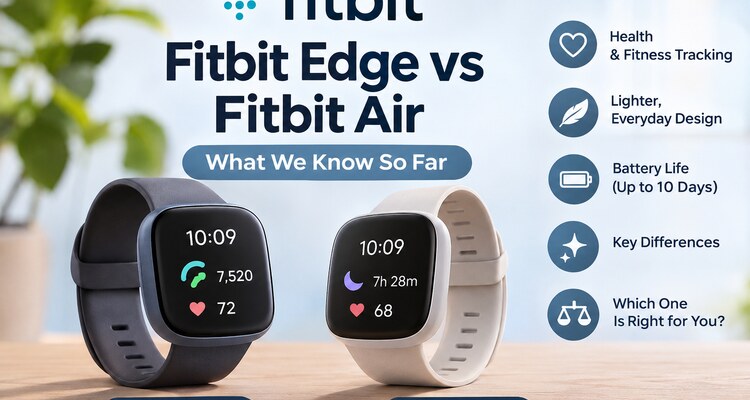
Fitbit Edge and Fitbit Air represent two approaches to personal fitness tracking: a more interactive wearable experience and a simpler, less distracting way to follow everyday health trends.
Choosing between them is not just about buying the device with the longest feature list. The better choice depends on how often you exercise, whether you want information directly on your wrist, and how much you value comfort, simplicity and long-term ownership costs.
This guide compares the two products using their official announcement pages. It is an editorial comparison, not a hands-on review. Product specifications, pricing and regional availability should be confirmed with Google before purchase.
Fitbit Edge vs Fitbit Air: The main differences
The biggest difference is the experience: Fitbit Edge is a screen-equipped tracker with built-in GPS, while Fitbit Air focuses on discreet, screenless health tracking.
| Feature | Fitbit Edge | Fitbit Air |
|---|---|---|
| Announced US price | $179.99 | From $99.99 |
| Display | Hybrid OLED | Screenless |
| Battery estimate | Up to 7 days | Up to 7 days |
| Workout tracking | 50+ on-device exercise modes and automatic recognition | Automatic activity detection and app-based workout tracking |
| GPS | Built-in | No built-in GPS advertised in the announcement |
| Google Health Coach | Supported; some features require Premium | Supported; some features require Premium |
| Ideal buyer | Workout-focused users who want on-wrist information | Minimalists focused on daily wellness and sleep |
Both battery figures are manufacturer estimates, not independently measured results. Availability and supported health features may vary by region.
Design and everyday comfort
A fitness tracker should fit naturally into daily life. Weight, band materials, controls and the way information is displayed can matter as much as individual tracking features.
For users who want immediate visual feedback, an interactive wearable may be more convenient during workouts and throughout a busy day.
For users who prefer fewer interruptions, a minimalist approach can be more appealing. Comfort is especially important for people who intend to wear a tracker overnight.
Before purchasing, compare the official dimensions, band options, water-resistance guidance and care instructions for both models.
Exercise tracking: What should you compare?
Different activities place different demands on a fitness tracker. A person who walks regularly may prioritize reliable daily activity summaries. Someone who runs, cycles or follows structured training sessions may care more about workout controls and location tracking.
When comparing Fitbit Edge and Fitbit Air, consider the following questions:
- Which activities can each device recognize automatically?
- Can workouts be started or reviewed directly on the wearable?
- Does the device offer built-in GPS, or does it depend on a connected phone?
- Which metrics appear during exercise?
- How easily can you review trends over several weeks?
The answers are more useful than a headline feature count. A tracker that fits your actual routine can offer better value than one with capabilities you rarely use.
Health tracking and sleep insights
Many buyers are interested in fitness wearables because they want to understand longer-term patterns in activity, recovery and sleep.
When evaluating either Fitbit, pay attention to which metrics are recorded automatically, how those measurements are presented in the companion app and whether particular insights require additional eligibility or subscriptions.
Consistency also matters. Wearing a device regularly can make trend information more useful, while frequently removing it may leave gaps in the data.
Consumer wearables can support wellness awareness, but they should not be treated as substitutes for medical diagnosis or professional care.
Google Health Coach and AI-powered guidance
AI-assisted health coaching is becoming an increasingly important part of the wearable experience. Instead of presenting isolated numbers, software can help users interpret patterns and develop more practical habits.
However, buyers should distinguish between basic tracking, standard app insights and features that require a paid subscription.
Before choosing a device, check whether the coaching functions you want are supported in your country, what subscription terms apply and whether the guidance works with your preferred smartphone.
AI-generated health suggestions may be useful for general wellness planning, but they can be incomplete or incorrect and should not replace individualized medical advice.
Battery life and charging
Battery life affects how consistently people use a fitness tracker. A device that requires frequent charging can be inconvenient for overnight sleep tracking or multi-day trips.
Compare Google's published battery estimates for both products, paying attention to the test conditions. Actual endurance can vary with settings, connected features and exercise activity.
Charging convenience is also worth considering. A short charging session can be valuable for users who wear their tracker almost continuously.
Price and the real cost of ownership
Google announced Fitbit Edge at $179.99 and Fitbit Air starting at $99.99 in the United States. That makes Edge $80 more expensive upfront.
The extra $80 primarily buys a different kind of experience: a Hybrid OLED screen, integrated GPS, on-wrist workout information and more direct controls. Buyers who do not need those features may find Air the better value.
Illustrative 12-month ownership cost
Both announcements include a three-month Google Health Premium trial, subject to eligibility. Google's published US terms for Fitbit Air state that the subscription renews at $9.99 per month after the trial unless canceled.
| First-year scenario | Fitbit Edge | Fitbit Air |
|---|---|---|
| Device only, no paid subscription | $179.99 | $99.99 |
| Premium after 3-month trial (9 × $9.99) | $89.91 | $89.91 |
| Illustrative first-year total | $269.90 | $189.90 |
These are illustrative US calculations, not guaranteed checkout prices. They exclude sales tax, accessories and shipping. The same $9.99 monthly subscription assumption is applied to both devices for comparison; verify the current renewal rate and trial eligibility before purchase. Premium is optional.
Who should consider Fitbit Edge?
Fitbit Edge is worth examining if your priorities include a more interactive workout experience, immediate access to information and convenient controls while exercising.
Before paying extra for these capabilities, verify that its specific features match the sports and activities you actually perform.
Who should consider Fitbit Air?
Fitbit Air deserves consideration if you want a simpler fitness-tracking experience and prefer to review detailed information in a companion app rather than frequently interacting with the wearable.
Its suitability will depend on comfort, the health metrics available, smartphone compatibility and the current purchase price.
Which Fitbit offers better value?
There is no universal winner. The best value comes from choosing the tracker whose features you will use regularly.
For workout-focused buyers, prioritize activity support, controls and location-tracking capabilities. For everyday wellness users, prioritize comfort, consistent tracking, useful sleep insights and total ownership cost.
It is also sensible to compare warranty terms, regional availability and the ongoing software experience before making a final decision.
Final verdict
Fitbit Air is the stronger value choice for screen-free daily wellness tracking, while Fitbit Edge is the more capable option for people who want built-in GPS and real-time workout feedback.
At announced US prices, the decision comes down to whether those additional Edge features are worth $80 to you. Both offer up to seven days of claimed battery life and access to Google's broader health-coaching ecosystem, with subscription and regional restrictions for certain features.
Because Fitbit Edge is scheduled to reach stores on October 27, 2026, this is an announcement-based comparison rather than a hands-on verdict. Buyers should check current specifications, availability and subscription terms before ordering.
Related reading on Netzender
Fitness trackers are only one part of a broader digital wellness routine. If you are comparing how devices and apps help you understand your health, read our guide to Apple Health in iOS 27 for another perspective on health data and everyday tracking.
If your main reason for considering a screenless tracker is to reduce interruptions, our Android Digital Wellbeing guide offers practical ways to make your phone less distracting.
Official sources
Editorial disclosure: This comparison is based on published information rather than independent device testing. The featured image is an illustrative graphic, not official product photography.